 4G SIM News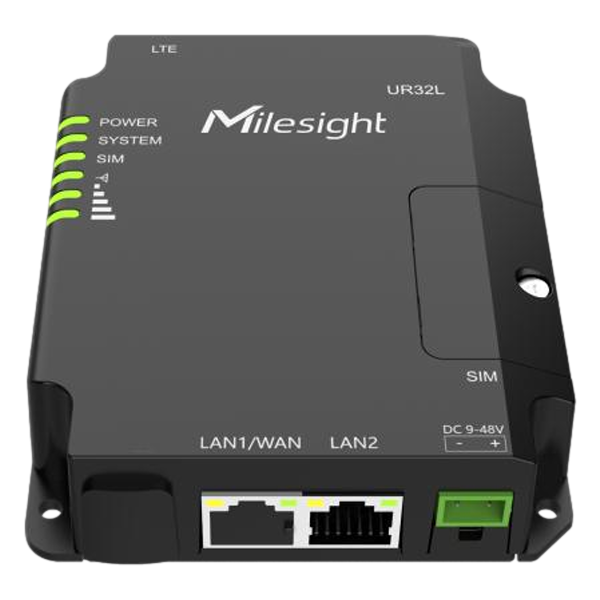
Milesight UR32L: Industrial 4G Connectivity for Straightforward Deployments
Not every deployment needs a router with dual SIM, serial ports, and digital I/O. Sometimes the requirement is simple: a reliable 4G cellular connection, two Ethernet ports, a solid VPN stack, and the ability to manage the device remotely without driving to site. That is exactly what the Milesight UR32L is built for.
The UR32L is the Lite Series in the Milesight industrial router range. It comes in two hardware configurations. The standard UR32L-L0GEU provides 4G cellular WAN and two Ethernet ports. The UR32L-L0GEU-P adds 802.3af/at PoE PSE output on both LAN ports, so it can power an IP camera or other PoE device directly without a separate injector. Both models share the same compact metal enclosure, the same industrial operating temperature range of -40 to +70°C, and the same full VPN capability.
This post covers both variants, the applications they suit, and how they compare to the UR32 Pro Series for buyers who need more hardware features.
The Two UR32L Variants
Milesight UR32L-L0GEU
The UR32L-L0GEU is the entry point. It provides 4G LTE Cat 4 cellular connectivity via a single SIM, two 10/100 Mbps Ethernet ports configurable as WAN plus LAN or two LAN ports, and automatic WAN failover from Ethernet to cellular if the primary link drops. Power consumption is a typical 1.8 W from a 9-48 V DC supply, which makes it practical for battery and solar-backed installations.
There is no Wi-Fi radio, no serial port, no digital I/O, and no MicroSD slot. That is not a limitation for the deployments it targets – it is the point. Fewer components means lower cost, lower power draw, and nothing to configure that is not needed.
Milesight UR32L-L0GEU-P
The UR32L-L0GEU-P adds 802.3af/at PoE PSE output on both LAN ports. Each port delivers up to 30 W, giving a total PoE budget of 60 W. This allows the router to power IP cameras, wireless access points, door entry panels, and other 802.3af/at devices directly – removing the need for a separate PoE injector or switch in the installation.
Everything else is identical to the base model: single SIM, two Ethernet ports, full VPN stack, same enclosure and temperature rating.
What the UR32L is Good At
Cellular Backup WAN
The most common use case for the base UR32L-L0GEU is cellular backup for a fixed broadband connection. The router monitors the Ethernet WAN port and switches to 4G automatically when the primary link goes down, then falls back when it recovers. This covers retail branches, small offices, kiosks, and any site where a broadband outage has a real cost. VRRP is supported for more advanced failover configurations.
Remote CCTV and IP Camera Power
The UR32L-L0GEU-P is well suited to remote camera installations where running separate power and data cabling is impractical. One device on the pole or in the cabinet provides the 4G backhaul to the monitoring platform and powers the camera on the PoE port simultaneously. Standard fixed cameras, PTZ cameras, and IP intercoms all fall within the 802.3at power budget. A fixed IP SIM card keeps the site addressable for the monitoring head-end.
Simple M2M and Remote Monitoring
Where a remote site has IP-connected devices – Ethernet-output sensors, data loggers, energy gateways, or managed switches – the UR32L provides the cellular WAN path without unnecessary hardware overhead. The data travels over a WireGuard or IPsec tunnel to the operations centre or cloud platform. SNMP v3 and TR-069 cover monitoring and management without the need for a proprietary platform.
Payment Terminals and Retail Kiosks
POS terminals and self-service kiosks need a reliable always-on connection with a fixed IP for inbound VPN access. The UR32L covers this cleanly. The absence of a Wi-Fi radio removes one potential attack vector on sites where wireless security policies are strict. Pair with a fixed IP SIM and a WireGuard tunnel for secure inbound access from the payment processor or support team.
Temporary and Portable Site Connectivity
The UR32L’s 1.8 W draw and 9-48 V DC input range suit temporary or mobile installations – construction site welfare units, portable event infrastructure, or equipment trailers. The DIN rail form factor fits standard temporary distribution boards. The router reconnects to the management platform and re-establishes VPN tunnels automatically on power-up.
Remote Management: Milesight Development Platform
Both UR32L variants are compatible with the Milesight Development Platform and DeviceHub for centralised remote management. From the platform, an engineer can push configuration changes, run firmware updates, monitor cellular signal and connection status, and set up event alerts across a fleet of deployed units – all without physical access to each site.
SNMP v1/v2c/v3 with SNMP Trap and TR-069 are also supported, so the UR32L integrates with existing NMS infrastructure rather than requiring a separate management tool. MilesightVPN provides a private overlay network between deployed units where a mesh or hub-and-spoke topology is needed.
For an organisation deploying a fleet of UR32L routers across multiple sites – retail branches, remote monitoring points, or backup WAN installations – the platform reduces the time cost of managing each unit significantly.
VPN: Not Cut Down on the Lite Model
One thing worth being direct about: the UR32L carries a full VPN stack. OpenVPN client and server, IPsec client and server, WireGuard, ZeroTier, GRE, DMVPN spoke, L2TP client, and PPTP client are all present. This is not a stripped-back selection. The Lite label refers to the hardware feature set – serial ports, I/O, dual SIM – not the software capability.
For deployments where the requirement is a secure cellular connection with a reliable VPN tunnel, the UR32L delivers that at a lower hardware cost than the Pro Series. The security model is the same.
When to Step Up to the UR32 Pro Series
The UR32L covers a wide range of common IoT and M2M scenarios, but there are deployments where the Pro Series hardware is the right choice. Here is what you gain by moving up.
Dual SIM Carrier Failover
The UR32L carries one SIM. The UR32 Pro Series carries two, with automatic failover between carrier networks. If your deployment is in an area with patchy coverage from any single operator, or if the uptime requirement is high enough that a SIM-level outage is not acceptable, dual SIM provides the resilience the Lite model cannot.
RS232 or RS485 Serial Port with Modbus Gateway
A large installed base of industrial instruments – flow meters, energy analysers, PLCs, environmental sensors – communicates over RS232 or RS485 with Modbus RTU. The UR32 Pro includes a serial port with a built-in Modbus RTU-to-TCP gateway. No additional protocol converter is needed. The UR32L has no serial port, so any device that communicates over RS232 or RS485 requires a separate converter before it can connect.
Digital Input and Output
The UR32 Pro has one galvanically isolated digital input and one digital output. The input can monitor door contacts, pressure switches, float valves, or pump run signals and trigger an SMS or MQTT alert on state change. The output can switch a relay remotely via SMS or MQTT. Neither function is available on the UR32L.
MicroSD Storage and Python SDK
The UR32 Pro includes a MicroSD slot for local data logging and a Python SDK for running custom application logic on the router itself. The UR32L has neither. For deployments where local storage or edge processing is part of the application, the Pro Series is required.
Optional GPS and Wi-Fi
Certain UR32 Pro variants add GNSS positioning or 2.4 GHz Wi-Fi. These are hardware options that do not exist in the UR32L range at all.
Which UR32L Should You Choose?
If your installation has a 48 V DC power supply available and you need to power an IP camera, access point, or other PoE device from the same unit, the UR32L-L0GEU-P is the correct model. It saves a PoE injector, simplifies the panel, and reduces failure points.
If your installation runs from a 12 V or 24 V supply, or if the connected devices have their own power and you just need a cellular router with Ethernet and VPN, the UR32L-L0GEU is the right choice. It costs less, draws slightly less power, and there is nothing to configure around PoE.
Both models are in UK stock. UK-based technical support is available on 0300 124 6181 for pre-sales advice on the right configuration for your deployment.
Milesight UR32L at Routerstore.com
UR32L-L0GEU – Industrial 4G Router – Single SIM, 2x Ethernet, full VPN stack
UR32L-L0GEU-P – Industrial 4G Router with PoE – As above, plus 802.3af/at PoE PSE on both LAN ports
Milesight Development Platform – Remote fleet management and configuration