 4G SIM News
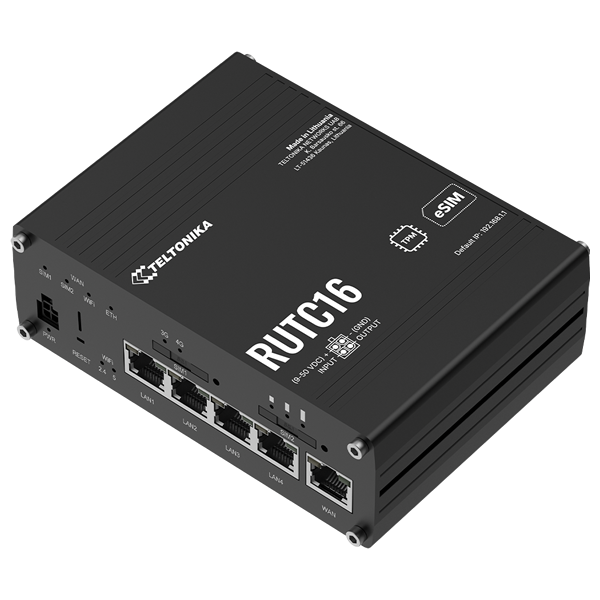
The Teltonika RUTC16 is an industrial 4G router designed for applications that need more than a basic mobile internet connection.
It combines global 4G LTE Cat 6 connectivity, dual SIM resilience, Wi-Fi 6, five Gigabit Ethernet ports and satellite positioning with enough processing power to run Docker containers directly on the router.
That last feature is what separates the RUTC16 from most conventional 4G routers.
A normal cellular router connects local equipment to the internet. The RUTC16 can also run software locally, process information from connected equipment and make certain decisions without sending every piece of data to a remote cloud platform.
In practical terms, it is part router, part small industrial edge computer.
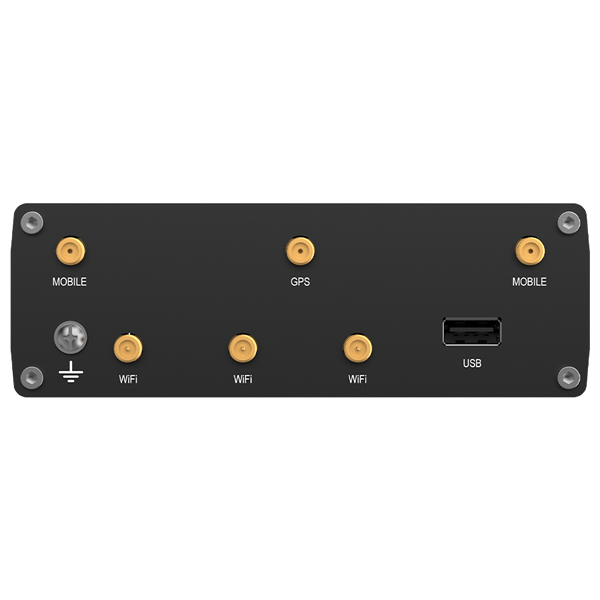
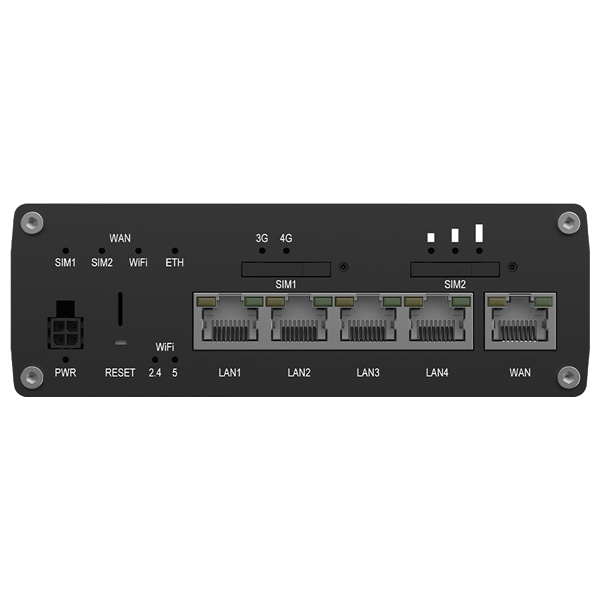
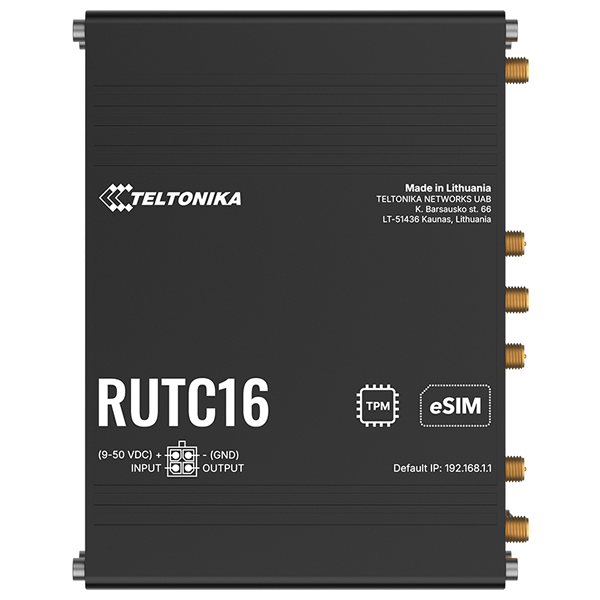
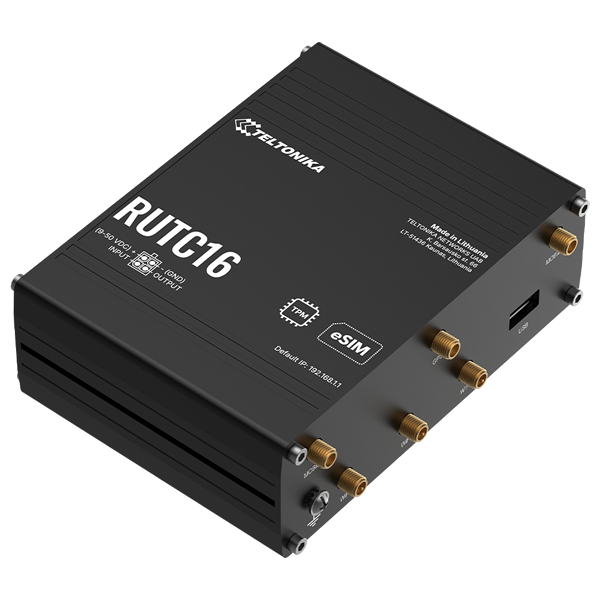
What is the Teltonika RUTC16?
The RUTC16 is a rugged industrial router with an integrated Telit LTE Cat 6 modem. It can provide an internet connection using a 4G SIM card and distribute that connection over Ethernet or Wi-Fi.
Its key specifications include:
| Feature | Teltonika RUTC16 specification |
|---|---|
| Mobile connectivity | Global 4G LTE Cat 6 with 3G fallback |
| Maximum 4G download speed | Up to 300 Mbps |
| Maximum 4G upload speed | Up to 50 Mbps |
| SIM support | Two Mini SIM slots plus eSIM |
| Mobile antennas | Two SMA connections supporting 2×2 MIMO |
| Wi-Fi | Dual-band Wi-Fi 6 |
| Ethernet | Five Gigabit Ethernet ports |
| Processor | Dual-core 1.3 GHz ARM Cortex-A53 |
| Memory | 1 GB DDR4 RAM |
| Storage | 8 GB eMMC plus 16 MB NOR flash |
| Container support | Docker |
| Positioning | GPS, GLONASS, Galileo, BeiDou and QZSS |
| Additional interfaces | USB 2.0, digital input and digital output |
| Power input | 9–50 V DC |
| PoE | Passive PoE input on LAN1 |
| Operating temperature | −40°C to +75°C |
| Housing | Industrial anodised aluminium |
| Operating system | Teltonika RutOS |
| Remote management | Teltonika RMS support |
The figures above are maximum technical capabilities. A Cat 6 router does not guarantee a 300 Mbps internet connection. Real speeds depend on the mobile network, available frequencies, signal quality, network congestion, antenna installation and the data service attached to the SIM card.
Why has Teltonika created another 4G router?
With so much attention given to 5G, a new high-performance 4G router might initially appear slightly odd. It makes more sense when you look at how industrial connectivity is actually used.
Many IoT installations do not require multi-gigabit 5G speeds. They need:
- Dependable coverage
- Predictable hardware
- Multiple network options
- Secure remote access
- Long-term availability
- Industrial power and temperature tolerances
- Local processing
- Centralised management
The mobile connection might only be carrying telemetry, alarms, transactions, compressed images or selected video clips. In those cases, 4G Cat 6 can provide more than enough capacity.
The expensive part of an industrial project is often not the data speed. It is installing equipment, integrating it with existing systems, visiting remote sites and maintaining hundreds or thousands of deployed devices.
The RUTC16 exists because organisations increasingly want a router that can do more work locally without automatically moving to a more expensive 5G platform.
It fills the space between an ordinary industrial 4G router and a separate router-plus-edge-computer installation.
What does 4G Cat 6 mean?
LTE categories describe the theoretical capabilities of a 4G modem.
A basic LTE Cat 4 router can theoretically download at up to 150 Mbps. The RUTC16 uses LTE Cat 6, increasing the theoretical download rate to 300 Mbps.
Cat 6 also supports carrier aggregation. This allows the modem to combine compatible portions of mobile spectrum rather than relying on a single LTE carrier.
For example, a mobile network might combine capacity from an 800 MHz band with another carrier operating at 1800 MHz or 2600 MHz. The lower frequency can provide broader coverage, while the higher frequency adds capacity.
The actual combination is decided by the mobile network. The router cannot force an operator to provide carrier aggregation where it is not available.
Cat 6 is therefore useful for more than headline speed. It can improve the router’s ability to use the capacity available at a particular location.
Dual SIM and eSIM resilience
The RUTC16 provides two physical Mini SIM slots and eSIM capability. This creates several possible connectivity arrangements.
A business could install:
- Two SIM cards using different UK mobile networks
- A primary UK SIM and a roaming backup SIM
- One physical SIM and one or more downloadable eSIM profiles
- A fixed-IP SIM for remote access and a standard data SIM for backup
- Different SIMs for deployment in different countries
RutOS can be configured to switch between connections following events such as:
- Loss of mobile service
- A failed data connection
- Weak signal
- Roaming
- Reaching a data allowance
- Reaching an SMS limit
- A network rejecting the connection
Dual SIM does not mean that both physical SIM cards are simultaneously transferring data through two independent modems. The RUTC16 contains one cellular modem and switches the active service when necessary.
Its eSIM feature also should not be confused with an inclusive mobile tariff. The router provides the eSIM hardware and profile-management capability, but a suitable profile must still be obtained from a connectivity provider.
Check the exact RUTC16 order code before purchasing, because Teltonika features can vary between regional and eSIM variants.
What makes it an edge router?
Edge computing means processing data close to where it is produced.
Consider an industrial site containing sensors that generate readings every second. A conventional router forwards those readings to a cloud server, where an application stores and analyses them.
An edge application can perform some of that work inside the site. It might:
- Discard duplicate readings
- Convert data into a common format
- Calculate hourly averages
- Detect an abnormal condition
- Store information while the mobile network is unavailable
- Send only alarms and useful summaries to the cloud
- Continue controlling equipment during an internet outage
The RUTC16 supports Docker containers, allowing suitable packaged applications to run separately from the main RutOS router software.
Its dual-core processor, 1 GB of RAM and 8 GB of eMMC storage give it considerably more computing capacity than a conventional industrial router. It is not a replacement for a powerful server, but it is capable of running targeted edge applications and small services.
This can remove the need for a separate Raspberry Pi, industrial computer or protocol gateway in some installations.
Fewer boxes can mean lower hardware costs, simpler cabling and one less device requiring power, maintenance and remote management.
Teltonika RUTC16 use cases
Industrial automation
Factories and processing sites frequently contain PLCs, controllers, meters and sensors using different industrial protocols.
The RUTC16 can connect this equipment to a central platform using Ethernet, 4G or Wi-Fi. RutOS supports technologies including Modbus TCP, OPC UA, DNP3, DLMS/COSEM and MQTT.
A Docker application could collect information from several machines, convert it into a consistent format and transmit only the required records to the cloud.
If the 4G connection goes down, the local application could continue collecting data and forward it after connectivity has been restored.
Remote monitoring and telemetry
Water infrastructure, pumping stations, environmental monitors and unattended plant rooms often need a reliable connection from places where fixed broadband is unavailable.
The RUTC16 can connect monitoring equipment over Ethernet while using a 4G SIM for its wide-area connection.
Dual SIM failover can provide a secondary network, while the digital input can monitor a contact or alarm state. The digital output can potentially be used to control compatible external equipment.
Its −40°C to +75°C operating range also makes it suitable for unheated cabinets and demanding industrial environments.
CCTV and ANPR systems
Five Gigabit Ethernet ports allow the RUTC16 to connect cameras, recorders and other network equipment.
LTE Cat 6 provides more potential mobile capacity than a Cat 4 router, although continuous remote video can still consume substantial amounts of mobile data. Recording video locally and transmitting alarms, selected footage or lower-resolution streams will normally be more economical than uploading every camera continuously.
An edge application could potentially analyse events locally or manage how data is forwarded. The exact capability would depend on the software and the processing demands involved.
For remote access to cameras, users should consider whether they need a fixed-IP SIM, private APN, outbound VPN or Teltonika RMS. A standard consumer SIM will normally sit behind carrier-grade NAT and may not accept unsolicited inbound connections.
Retail and payment systems
Retail sites need reliable connectivity for payment terminals, tills, digital signage, stock systems and security equipment.
The RUTC16 can use a fixed broadband connection as its primary WAN and automatically fall back to 4G during an outage.
Its Wi-Fi 6 access point and Gigabit Ethernet interfaces allow local equipment to remain connected, while dual SIM support provides another layer of mobile resilience.
It could also suit temporary shops, exhibitions, ticketing systems and pop-up locations where a fixed connection is unavailable or cannot be installed quickly enough.
Transport and mobile assets
The router’s integrated GNSS support provides positioning using several satellite systems.
This can be useful for:
- Buses and coaches
- Service vehicles
- Mobile workshops
- Construction equipment
- Broadcast vehicles
- Temporary command centres
- Specialist trailers
- Portable monitoring systems
Geofencing can be used to trigger actions when an asset enters or leaves a defined location.
The 9–50 V DC input accommodates a broad range of power arrangements, although vehicle installations should still use proper voltage protection and professional installation practices.
Energy and utility infrastructure
Energy installations increasingly combine communications, monitoring and local intelligence.
Potential applications include:
- Battery energy storage systems
- Solar installations
- EV charging sites
- Substations
- Smart metering concentrators
- Generator monitoring
- Remote power-quality systems
Local processing can reduce the amount of raw telemetry sent over the mobile network. It can also allow selected functions to continue when cloud connectivity is interrupted.
Smart-city and roadside equipment
Traffic sensors, public information displays, roadside cabinets and environmental monitoring stations need equipment that can operate unattended.
The RUTC16 offers the combination of 4G connectivity, Gigabit Ethernet, GNSS, remote management and a wide operating-temperature range.
Docker support also allows a common hardware platform to be adapted for several projects by changing the software running on it.
Wi-Fi 6 and five Gigabit Ethernet ports
The RUTC16 includes dual-band Wi-Fi 6 rather than the older Wi-Fi standards found in many industrial routers.
Wi-Fi 6 can handle larger numbers of connected devices more efficiently and offers improved wireless performance in busy environments. Teltonika specifies support for up to 512 Wi-Fi clients, although a real industrial deployment should be designed around its actual traffic and reliability requirements—not merely the maximum association figure.
The router also provides five 10/100/1000 Mbps Ethernet ports:
- Four dedicated LAN ports
- One WAN port that can be reconfigured as another LAN port
This gives the RUTC16 enough wired connectivity for several local devices without immediately requiring a separate Ethernet switch.
Powering the RUTC16
The router accepts 9–50 V DC through its four-pin industrial power connector. It can also be powered through LAN1 using passive Mode B PoE.
This needs an important warning: the passive PoE input is not the same as IEEE 802.3af, 802.3at or 802.3bt PoE.
Do not assume that any PoE switch or injector is suitable. The power source must match the router’s stated passive PoE requirements. Using incompatible equipment can damage the router.
Average consumption is around 5 W during relatively light mobile operation, but consumption increases when the processor, Wi-Fi, Ethernet, GNSS and USB interfaces are placed under load. The power supply should therefore be sized for the complete installation rather than its idle consumption.
Remote management with Teltonika RMS
The RUTC16 works with the Teltonika Remote Management System.
RMS can be used to monitor and administer routers without travelling to each location. Depending on the services enabled, this can include:
- Router status and mobile signal monitoring
- Remote configuration
- Firmware updates
- Alerts
- Troubleshooting
- Access to equipment connected behind the router
- Bulk management of larger router estates
This is particularly useful when RUTC16 routers are installed in roadside cabinets, energy sites, retail branches or moving vehicles.
RMS is a separate service and may require credits or an appropriate management plan.
Is the RUTC16 suitable for every 4G project?
No. It is a capable router, but many installations do not need Docker, Wi-Fi 6, five Gigabit ports or 8 GB of storage.
A simpler Teltonika router may be more economical for:
- One alarm panel
- A single vending machine
- Basic CCTV access
- A small telemetry device
- Simple failover for one Ethernet connection
The RUTC16 becomes more compelling when the installation needs several of its higher-end features together.
It is particularly relevant when you need:
- Global LTE band support
- LTE Cat 6 carrier aggregation
- Multiple Ethernet devices
- Modern Wi-Fi
- Local Docker applications
- Dual SIM and eSIM flexibility
- GNSS positioning
- Remote fleet management
- Industrial power and temperature tolerances
It is also an interesting option where 5G would provide little practical benefit. Paying for a 5G router makes sense when the application genuinely needs greater throughput, lower latency or access to a particular 5G service. It makes less sense when a reliable 4G connection already exceeds the application’s requirements.
Choosing a SIM for the RUTC16
The best SIM depends on what the router is expected to do.
A high-data SIM may be appropriate for video, public Wi-Fi or large software transfers. A smaller pooled-data tariff may be more economical for telemetry and monitoring.
For resilience, the two physical SIMs should ideally use genuinely different underlying mobile networks. Two differently branded SIMs may still rely on the same host network, so the branding alone does not guarantee network diversity.
Remote access also needs to be considered. Most ordinary mobile SIMs use carrier-grade NAT. This is perfectly suitable for web browsing and outbound cloud connections but prevents simple inbound access from the public internet.
Possible remote-access options include:
- Teltonika RMS
- An outbound VPN
- A private APN
- A fixed-IP SIM
- A secure overlay network
A public fixed IP should be properly protected with firewall rules and a VPN. Connecting an industrial router directly to the public internet with unnecessary services exposed is asking for trouble—usually from automated scanners rather than a mysterious hoodie-wearing mastermind.
RUTC16 glossary
4G LTE: The fourth-generation mobile network technology used by the router to connect to a mobile operator.
LTE Cat 6: A modem category supporting theoretical downloads of up to 300 Mbps and carrier aggregation.
Carrier aggregation: The process of combining compatible LTE carriers to increase available capacity.
Dual SIM: Two physical SIM slots that allow the router to switch between mobile services. It does not mean that the router contains two independent cellular modems.
eSIM: An embedded SIM that downloads operator profiles electronically instead of requiring every service to be supplied on a removable card.
MIMO: Multiple-input, multiple-output. It uses more than one antenna path to improve mobile or Wi-Fi performance.
Edge computing: Processing information close to the equipment producing it rather than sending everything to a distant cloud server.
Docker container: A packaged application with the files and dependencies it needs to run. Containers allow custom applications to operate on the router separately from its main operating system.
GNSS: The collective term for satellite-positioning systems such as GPS, Galileo, GLONASS and BeiDou.
Gigabit Ethernet: Wired networking capable of a theoretical one gigabit per second.
Failover: Automatically moving to a backup connection when the primary connection fails.
RutOS: Teltonika’s OpenWrt-based router operating system.
RMS: Teltonika’s cloud-based Remote Management System.
CGNAT: Carrier-grade network address translation. Mobile operators use it to share public IP addresses among many customers, but it normally prevents direct inbound connections.
Fixed-IP SIM: A mobile data SIM providing a consistent IP address. Some services provide a public IP, while others use a private APN or managed VPN.
Where to buy the Teltonika RUTC16 in the UK
The RUTC16 is available in the UK from The Router Store.
The UK package includes the router, UK power supply and the relevant mobile, Wi-Fi and GNSS antennas. Check the listed order code and eSIM configuration before purchasing, particularly when planning a multi-network deployment.
View the Teltonika RUTC16 at The Router Store
Final thoughts
The RUTC16 is not simply another 4G router with a faster processor added to its specification sheet.
Its purpose is to bring connectivity and local computing into one industrial device. It can provide the mobile connection, manage wired and wireless equipment, switch between SIM services, report its location and run a customised application at the deployment site.
For straightforward remote connectivity, it may be more router than is necessary. For industrial automation, utilities, transport, retail resilience, roadside infrastructure and distributed IoT systems, the combination makes considerably more sense.
The interesting question is no longer just, “How do we connect this equipment?”
With the RUTC16, it becomes, “What work can we complete locally before the data ever leaves the site?”